Photo: James Bryan displays some of the 30 medals he was awarded during his military career. He is especially proud of his Saint Barbara medal, which is reserved for personnel who make special contributions to artillery operations. Photo by Valeriia Radchenko
By Steve Bornhoft
James Bryan was 10 when federal revenuers, accompanied by the sheriff of Walton County, Florida, showed up at the home of his grandmother, Lily Mae Paul.
For years, she and her sister, Evi Lee Long, had been selling moonshine in concert with a local farmer who produced the liquor. They kept their inventory beneath a couch.
Bryan, from age 6 forward, had been called upon to scour roadsides for discarded whiskey bottles that his grandmother and great aunt would put back to use.
Paul and Long raised Bryan in the tiny town of Paxton in the absence of his father, whom Bryan never knew, and with little help from his mother, who was kept busy running her tavern, the all too aptly named Bloody Bucket.
His mother met Bryan’s father when he was playing steel guitar for Hank Williams’ band at a bar in Florala, Alabama.
The law enforcers confiscated the moonshine at Granny’s place and hauled Aunt Evi off to jail in the county seat of DeFuniak Springs. She would remain there for but an hour.
A judge quickly dispensed of the case, letting Long off with a fine. She surely recognized him. He, along with the sheriff, mayors and preachers, was a customer.
Bryan, who was born on Oct. 6, 1947, in Montgomery, Alabama, was nearsighted from a young age. He dropped out of school as a fifth-grader in part because he was without the eyeglasses he needed and couldn’t see the blackboard.
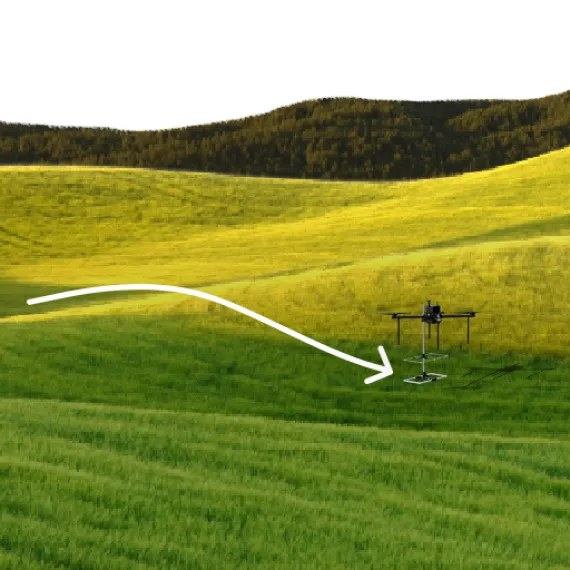
Bryan is familiar to all who work at TechFarms. He helps promote the business and its tenant companies and is an inventor whose interests currently include riptides and new methods for detecting them. He is passionately interested in ArroTech’s mine-detecting drone project.
“I want to accompany drones to Ukraine and help clear mines from the grain fields over there,” he said. “That is a mission with worldwide implications.”
While a teenager, Bryan enlisted in the Army. The Vietnam War was raging. He was assigned to a Howitzer section, part of the field artillery operations within the 101st Airborne Division. In October 1967, he would experience the heaviest fighting that battery would face during its seven years in Vietnam.
A contingent of 200 members of the North Vietnamese Army (NVA) launched a nighttime rocket and mortar attack on Bryan’s battery at 11 p.m. When the shelling stopped, the NVA commenced a ground assault.
Bryan was part of a five-member section presided over by a corporal and including a staff sergeant. The SSG was away on a supply run when the corporal was killed. Bryan and two others were left to man the Howitzer as the NVA advanced in waves.
When the NVA knocked out the cannon, Bryan picked up an M60 machine gun. When it overheated, he was reduced to an M16 rifle. Had the enemy known he was so lightly armed, it surely would have overrun his position, but they assumed otherwise.
Nonetheless, Bryan was wounded three times in four hours during the battle. Once, when a round from an AK47 ricocheted off the Howitzer and chipped his left kneecap; subsequently when a grenade explosion damaged his face, eyes, ears, back arms and legs; and again when fragments from a mortar shell struck his right thigh and groin.
He spent two months in an evac hospital where shrapnel was removed from his head and body and gunshot from his knee. He considered himself fortunate.
Upon recovering from his injuries, Bryan rejoined his unit at a hill in the Ashaw Valley, and was wounded yet again, this time by friendly fire. Two F4 Phantom jets destroyed his battery, killing 16 artillerymen and 16 infantrymen. Bryan was concussed by the 500-pound bombs dropped from the Phantoms. His eardrums were ruptured, and he had blood in his lungs. He was hospitalized for a month.
Upon his release, he returned to the field with the infantry as a radio operator.
Bryan was within 15 days of completing his tour and had been sent to the rear when he was approached by a command sergeant major, who had been notified that an NVA attack was imminent. The CSM, lacking any personnel with combat experience, pressed Pvt. Bryan into service as a sergeant at arms.
He was placed in charge of four bunkers and 16 men — cooks, clerks and motor pool mechanics. While severely outnumbered, Bryan and his charges held the bunker line. For his actions as an emergency unit leader, he was awarded the Silver Star.
A one-star general dubbed Bryan “Captain America” after discovering that he had earned 11 decorations in one year.
Bryan would complete three tours in Vietnam. He undertook a classified mission at the time of the Tet Offensive in 1968. In total, his military career lasted 19 years, two months and 15 days. Eventually, the cumulative effects of his injuries forced him to retire after attaining the rank of master sergeant. His collection of medals includes that Silver Star; three Bronze Stars; two Vietnam Cross of Gallantry awards; and three Purple Hearts.
He has been nominated to receive the Congressional Medal of Honor.
“I am 70 percent Choctaw Indian,” Bryan said. “I was 6 or 7 when my grandmother said to me, ‘You are a warrior.’”